



Analysis of Safety Behavior in Maintenance
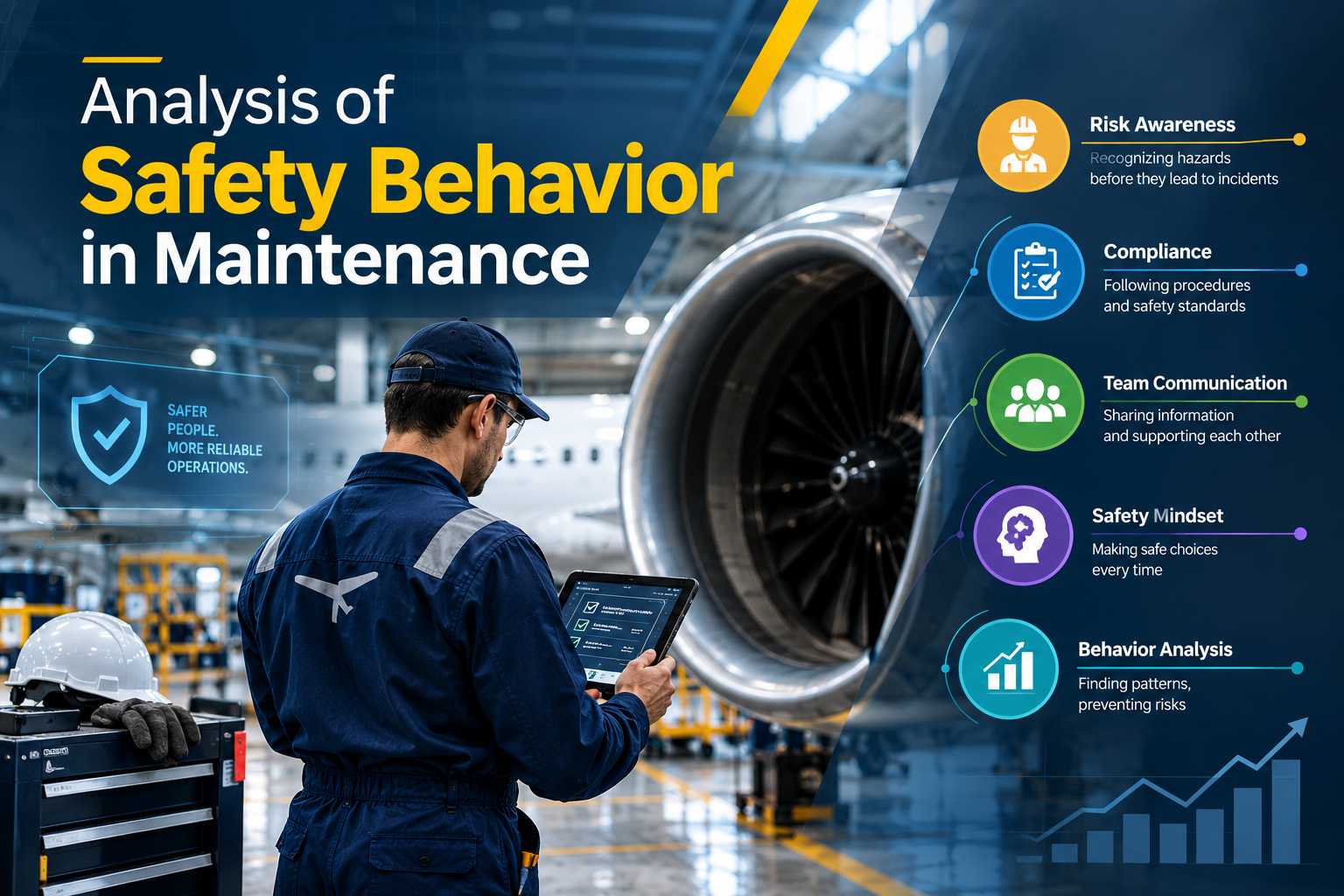
The objective of this study is to examine employees’ safety behavior and its relationship with safety leadership, safety communication, safety commitment, and safety climate. This research was conducted in the Indonesian aviation industry in 2021, with the participation of 2,400 employees.
Indonesia is one of the regions with the highest fleet growth rates among countries, reaching 7.4%. To ensure aircraft performance and safety, regular maintenance and periodic repairs are required to be carried out by aircraft maintenance organizations, commonly known as Maintenance, Repair, and Overhaul (MRO) organizations.
The growth of the aircraft business inevitably affects the demand for MRO services, as maintenance becomes an absolute necessity for every fleet. This condition makes MRO a strategic industry within the aviation sector. The MRO industry also plays a significant role in generating foreign exchange and contributing to the growth of the local economy. Furthermore, the growth of the MRO industry creates high-technology employment opportunities and generates a multiplier effect across supporting industries.
Kinnison, in his book Fundamentals and Strategies of Maintenance, stated that maintenance refers to a process through which a system continues to perform its standard functions at an acceptable level of reliability and safety. Meanwhile, Wills emphasized that the purpose of maintenance is not only to minimize the time required to perform repairs, but also to increase product reliability and obtain relevant information for analysis.
The MRO industry continuously faces various challenges and requires ongoing efforts to overcome them so that the aviation sector can survive, grow, and develop. One of the ongoing efforts is to address workplace accidents, which often result in injuries to individuals as well as losses for companies. Workplace accidents are a major cause of reduced individual productivity. Occupational accidents occur due to numerous factors, one of which is the human factor.
The quality of occupational safety within a company is highly important for improving safety behavior. Creating an appropriate occupational safety environment requires the role and participation of both managers and employees, which ultimately influence the safety behavior of each individual within the organization.
Managers who emphasize the importance of safety among company members strengthen the safety climate and subsequently encourage employees to adopt behaviors that prioritize the value of occupational safety, namely safety behavior. Safety leadership is a process through which managers ensure that teams participate in promoting safety values and maintaining team efforts to achieve organizational safety objectives.
Safety leadership is based on a concept that fulfills three aspects: safety motivation, safety policy, and safety concern.
To promote the importance of occupational safety values, effective communication must be established among organizational members. Communication helps employees understand conflicting objectives, reduce uncertainty, and provide a basis for consensus regarding appropriate ways of performing work.
Furthermore, applying safety values requires commitment. Safety commitment can be measured through four aspects of managerial actions: decision-making, management policy, active participation, and communication with the workforce. Indeed, in some safety literature, safety commitment has been emphasized as an important influence on organizational safety and as a core component of safety climate or safety culture.
Safety climate is described as the priority given to occupational safety, and this perception, in turn, predicts the behavior that is observed. Safety climate refers to employees’ perceptions of the work environment and the occupational safety regulations and practices that exist within it.
In addition, safety climate has a direct influence on safety behavior. Safety climate is often associated with the occurrence of workplace accidents because it may affect the number of accidents occurring within organizations. Positive safety perceptions among employees influence workers’ occupational safety behavior.
Safety Behavior
Behavior is simply an actual activity demonstrated by a person in relation to other people and the surrounding world. Employees, as members of an organization, act according to company policies. The term safety behavior refers to activities performed by individuals within an organization that are related to safety.
Safety behavior, as an early indicator of safety performance, offers several advantages over lagging indicators such as injuries and fatalities. Safety behavior data often have a regular distribution, making relationships with antecedent factors easier to interpret, more reliable, and more useful for safety assessment and intervention.
Safety behavior is inseparable from safety performance and is influenced by multiple processes. It is generally classified into two main categories: safety compliance and safety participation.
Safety compliance refers to safety-related actions that are part of an employee’s formal role, such as complying with safety regulations and following safety instructions. Safety participation refers to safety-related behaviors that are not formally required as part of an employee’s role and are generally voluntary, such as being willing to support colleagues, regularly participating in safety training programs, and providing safety recommendations.
Based on the above definition, it can be concluded that safety behavior refers to employees’ safety-related activities in the workplace, expressed through actions taken by employees to create and improve safety within the work environment.
Safety Leadership
Safety leadership is defined as a complex construct that reflects safety values through attitudes and activities that directly influence workplace safety.
Meanwhile, safety leadership is an interactive process between managers and organizational members in which managers guide members toward achieving organizational safety objectives. Therefore, supervisors or managers must communicate and operationalize safety concerns.
Safety leadership can serve as a process for achieving desirable conditions and preparing for participation in and success of strategic efforts to promote safety. Safety leadership is generally recognized as an essential element of business success. Conversely, poor safety leadership can impair an organization’s ability to achieve its strategic objectives.
Safety leadership is a process in which managers form and lead teams, ensuring that teams participate in strengthening safety values and maintaining their efforts to achieve organizational safety objectives. In addition to focusing on individuals and teams, this type of leadership also maintains the integrity of the machines and technologies used to meet operational procedure standards so that the desired safety objectives can be fully achieved.
Ineffective safety leadership often results from uncertainty regarding the company’s safety management program and related policies. This causes managers to become confused about their responsibilities and commitments concerning the integration of changes and flexibility within the organization.
Safety Communication
The purpose of communication is to transmit information within an organization so that the recipient can clearly understand the communicator’s intentions, particularly the actions that the organization expects the recipient to understand and perform. Communication is a critical component of every human-centered program.
No actual and coherent operation can be effectively carried out without effective communication. This may refer to the process of transferring and sharing safety knowledge among members so that tasks can be performed safely or information about hazards can be obtained.
Safety communication can be either formal or informal. Formal communication refers to the sharing of knowledge through established channels. This includes formal communication with supervisors in the form of safety instructions, work orders, written procedures, safety signs, and other discussions.
On the other hand, informal communication takes place among members of a workgroup and does not have a formal structural basis. Informal interactions may take the form of advice, informal conversations, or the use of social media.
In summary, safety communication refers to effective communication regarding safety in order to obtain a better understanding of safety behavior and the risks associated with unsafe behavior.
Safety communication can be used to identify or monitor hazardous conditions before accidents occur. Based on the definitions above, safety communication can be defined as cross-functional communication focused on occupational safety practices, including protection, hazard management, and future incident prevention in the workplace, with the aim of minimizing risks to organizations and individual employees.
Safety Commitment
The four dimensions of decision-making, management strategies, constructive interaction, and contact with employees are referred to as safety commitment. Commitment to safety is one of the essential aspects of organizational safety. Specifically, it is considered one of the core elements of safety climate or safety culture.
The issue of safety commitment has emerged in studies of ineffective leadership, with a particular focus on the role of senior management in workplace accidents. In addition, the social information processing perspective suggests that individuals perceive their work environment through social information processing, while the concept of safety commitment is reflected in the observable behavior of managers. Behavior through which an individual expresses commitment is generally associated with the object or purpose of that commitment.
Based on the theories discussed above, safety commitment can be understood as a reflection of an organization’s commitment to occupational safety, as demonstrated through safety-related behavior. It is measured through employees’ perceptions of all efforts undertaken by management to promote and maintain safety.